
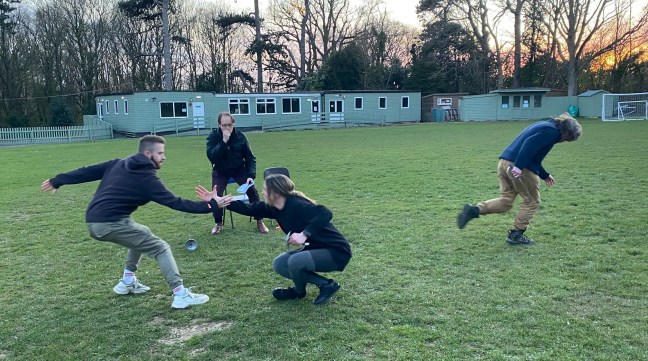
Fencing, Fisticuffs & Furniture

What better way to spend an evening than sword-fighting, goblet-wrestling and being smacked about with a chair in front of an entire Royal Court, I hear you cry?

Alright, so nobody is likely to be posing that question outside of ‘Hamlet’ rehearsals…

Fight calls for a stage production are great fun, but there are so many elements to consider, so with that in mind I thought it might be worth spending a couple of posts talking about the process behind the choreography of the fight and its subsequent rehearsal process.

After all, the fight that takes place in Act V Scene II of ‘Hamlet’ is really quite important!

First and foremost, a little background on Hamlet and Laertes, or rather the actors playing them. Hamlet, as you’ll have gathered if you read my ‘Finding Hamlet’ post, is played by me. Laertes, meanwhile, is played by my very dear friend Patrick Barry – affectionately known as Patch.

The (I think unrealised at the time of casting!) cherry on the cake of this pairing is that Patch is actually the one who trained me in stage combat, ten long years ago now, but whilst he trained me and has choreographed and supervised several fights that I have been a participant in since then, he and I have not actually come face to face as combatants in about 7 years!

Without spoiling anything major – not necessarily in terms of plot points, as frankly if you think ‘Hamlet’ has a happy ending then I would have to ask which rock you’ve been living under, but in terms of not spoiling all the little ‘extras’ – our rehearsals thus far have looked as follows.

Rehearsal 1: A slot at the end of a script rehearsal, with us working out simply the ‘finishing blow’ for each bout of the fight, with the nod of approval to each one from Si, our director. Si then places complete trust in us to ‘fill in the rest’, now we have his overall vision in mind.
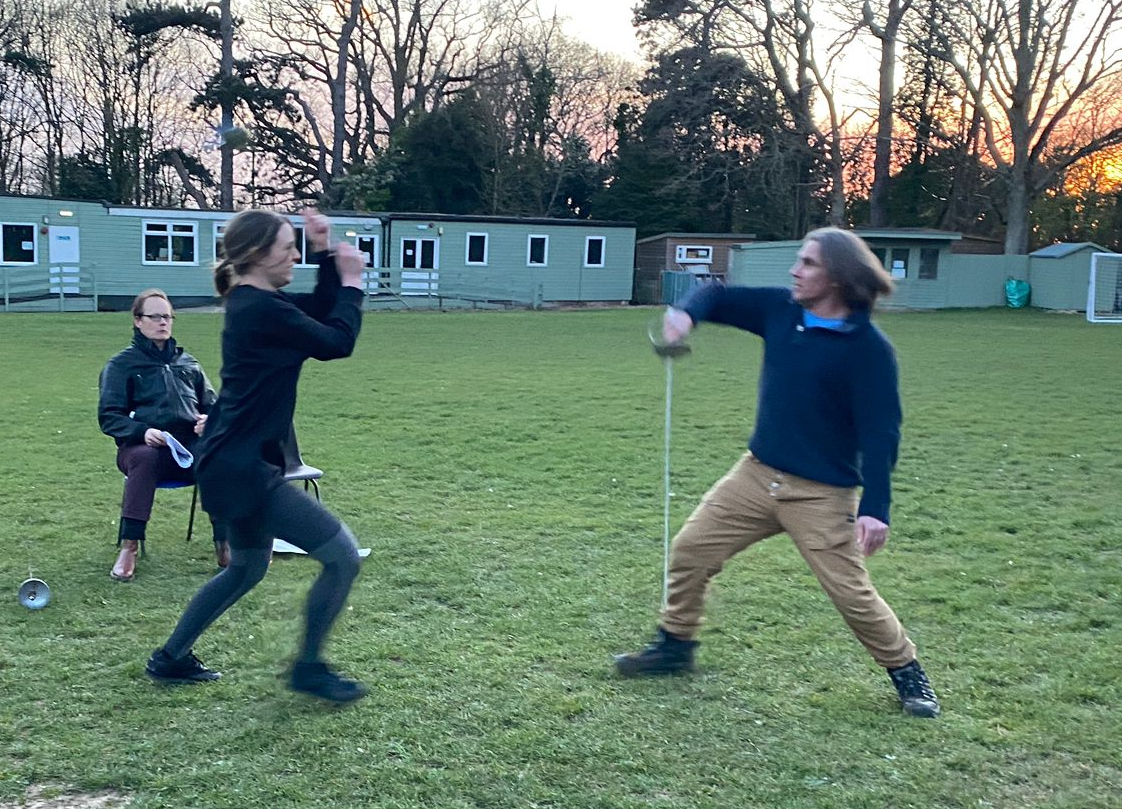
Rehearsal 2: Just Patch and I, in a hall, doing two and a half intensive hours of fight training. We choreograph each section, minus the big scuffle at the end as at the time there was talk of involving more people and ducking around the courtiers. We spend ages working on each move, making sure every one of them has a reason or a story, making sure the way we execute them and react to them is as Hamlet and Laertes rather than Emily and Patch. We’re finding their styles, finding their voices, and it’s exciting.
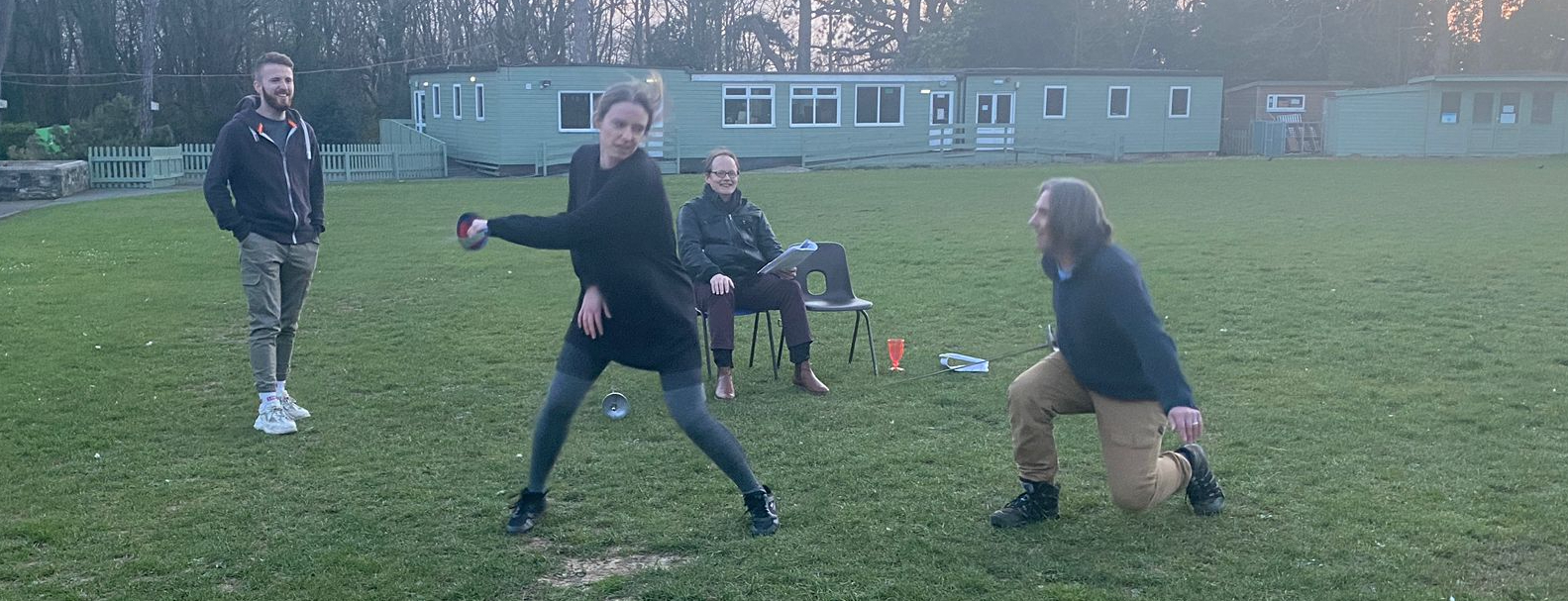
Rehearsal 3: A ‘final scene call’ for the whole cast…except, for one reason or another, we only have Claudius, Horatio, Laertes, Hamlet and Fortinbras. Here’s the thing about a fight like this – it needs practice. It has to look natural, raw, realistic. It has to become second nature. And it also has to be safe, not just for the fighters but for those around them. So if you want to involve others, even in something so simple as a chase, for the sake of safety they have to be there when it’s choreographed, to be spaced, and to learn how to recognise when a move has gone right and when it is going wrong so that they can, if needed, get out of the way. Out of the window, promptly, goes the idea of including others in the fight (with the exception of Horatio and Claudius, of course), but ultimately whilst at the time we were frustrated at the shift in vision, it turned out to be a blessing in disguise…
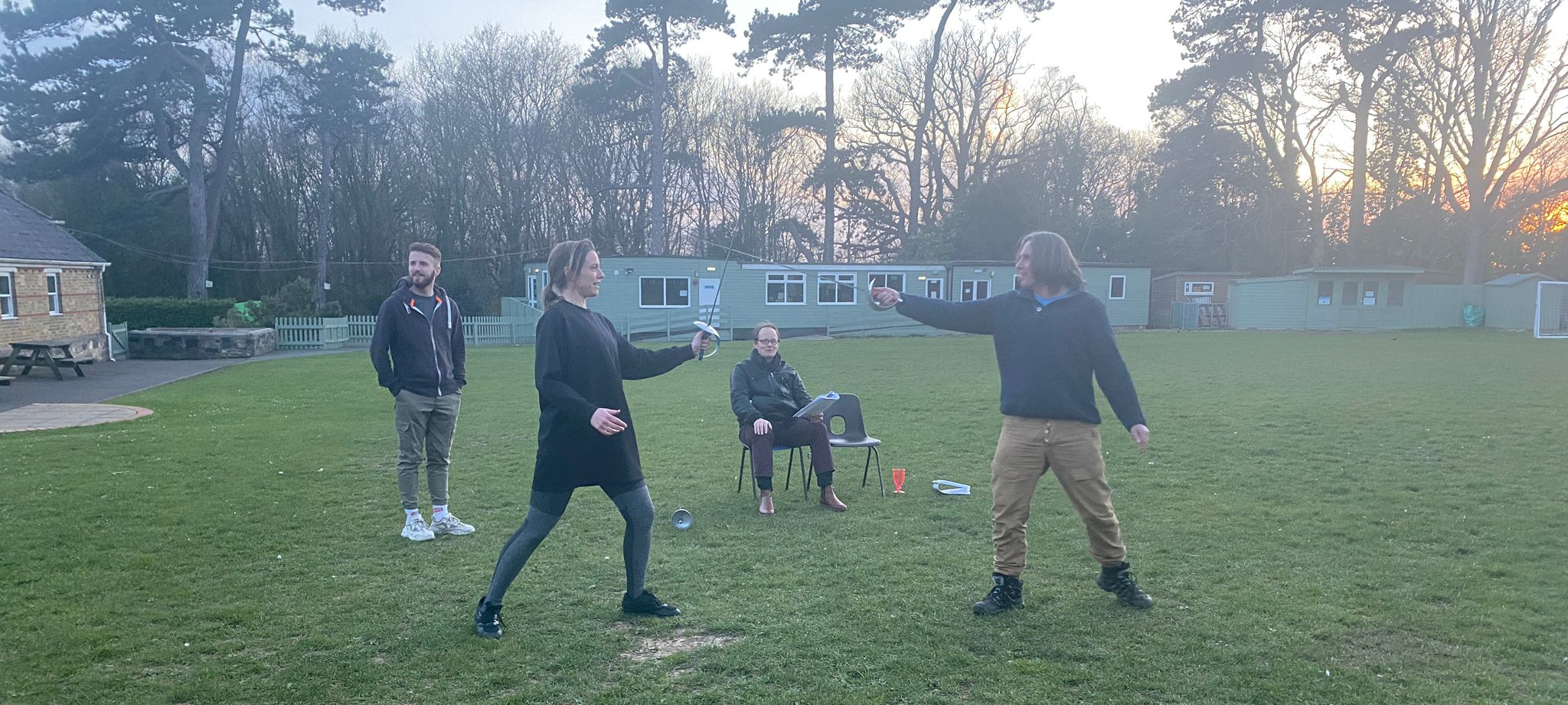
Rehearsal 4: …Because rehearsal four was electric. Utterly electric. Patch and I returned with renewed vigor and a clearer picture of how the final ‘scuffle’ needed to play out. We arrived at rehearsal early and, alongside Si, worked out exactly what we all wanted, and merged our ideas together. On the arrival of Horatio and Claudius we incorporated their respective sections, and now we have a fully fledged fight scene that just needs to be repeated, time and again, to sharpen and polish it.
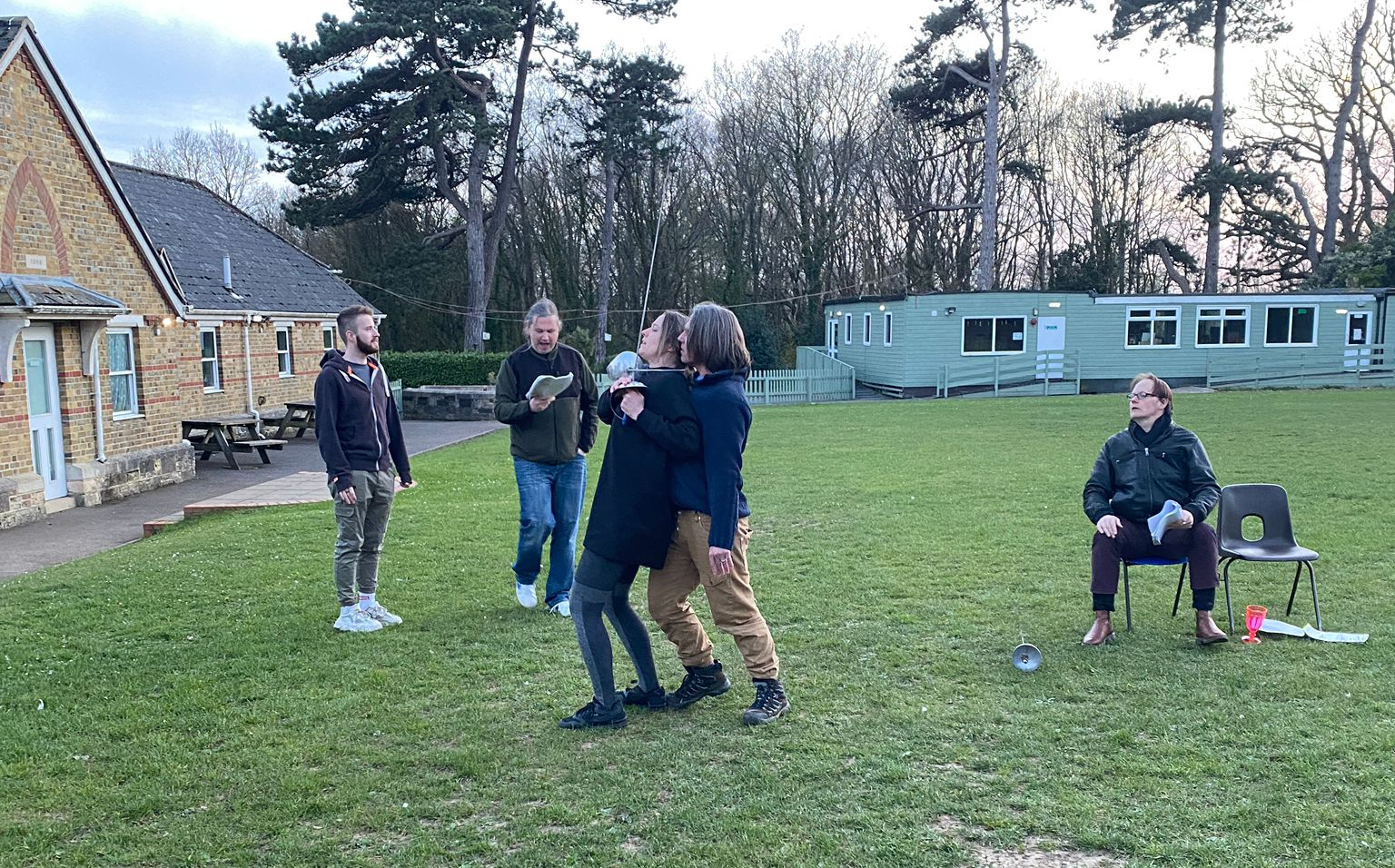
Rehearsal 5: Just Patch and I, for a quick meeting to commit the choreography to paper for reference. During this rehearsal, we also realised we were repeatedly getting stuck on one of the moves, and it became apparent that the reason was that it made no sense for either character, but in particular Laertes, for it to play out the way we had it. So we made one tiny tweak, as simple as adjusting the type of parry used, and the whole sequence fell into place.
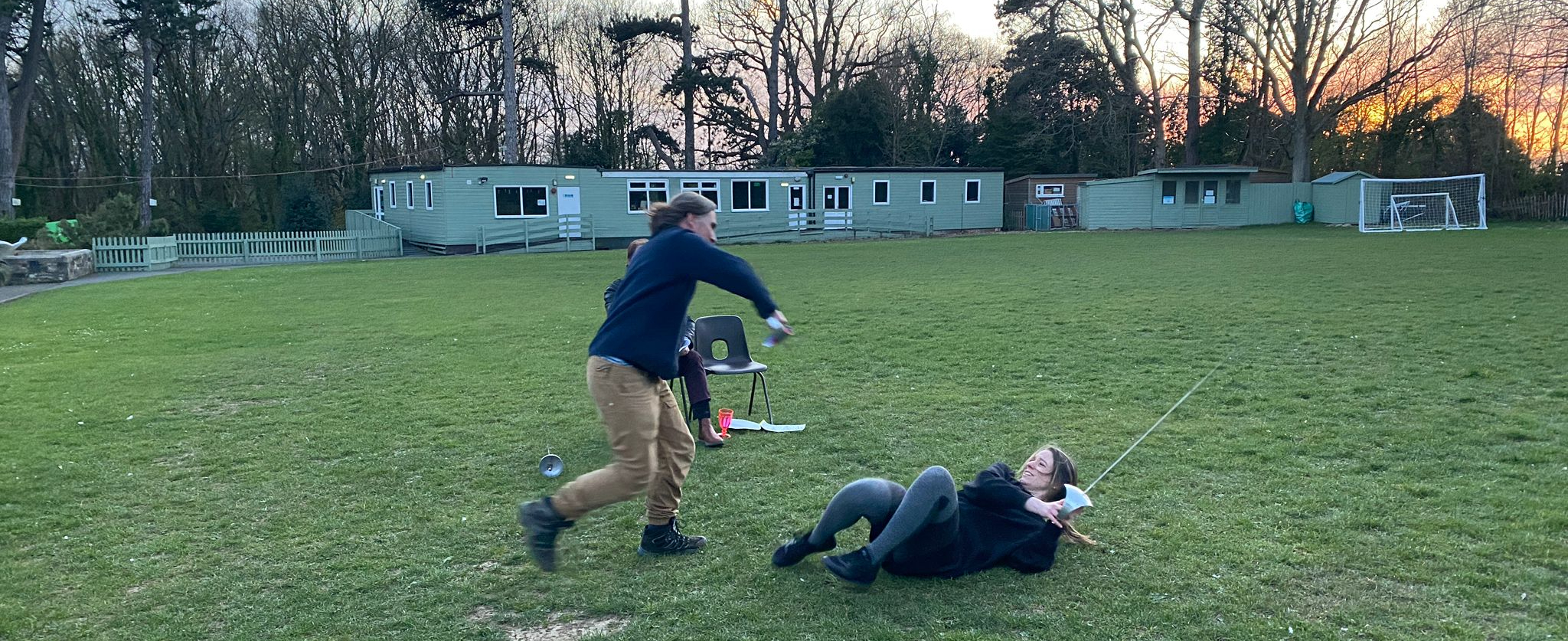
Rehearsal 6: This time, we met in a local park and ran the fight a number of times…and made a further tweak, quite by accident! We were running one of the bouts at mark speed (each move done at a steady pace, usually about half speed) and instinctively whilst disarming him I added a blow and he reacted to it. We stopped, grinned, and realised that actually what we’d just inadvertently added made the whole disarm more effective, and cleaner.

From now on, we will be running the fight on at least a weekly basis, twice weekly if we can, so that it is as polished as it can be, and so that it becomes as instinctive as every other element of the scene.

There are so many important elements to a fight like this one, which remains arguably one of the most iconic fictional duels in history. The plot is, obviously, critical – there are moments of action and dialogue outside of the fight itself, which are the lynchpins of that final scene.

The characters, too, are vitally important: there is absolutely zero point in putting a move in a fight that doesn’t fit the moment, the characters or the style you’re going for…all it will do is pull the audience out of the moment, and most likely the actors too. And for anyone who knows the final scene of ‘Hamlet’ and how physically and emotionally intense it is for the performers…yanking them out of character by forcing them to do something out-of-character is definitely best avoided!

But the most important element, for me personally, is trust.

There is a different level of trust required in your friends, to trust one of them to swing a chair at your head at exactly the right angle, and to trust the other to intercept the second swing before it can hit you in the back of the head while you’re still floored from Swing One.

I will say this many times over the coming months, I’m sure, but I am so deeply privileged to be working opposite two of my dearest friends in Patch and Ches (Horatio); that level of trust needed no work, because it was there already.

Trust between combatants takes a fight to a whole new level, especially when it’s mutual. It also increases the safety of the sight, by removing the element of fear: if something goes wrong, as can sometimes happen and sometimes through no fault of either fighter, if you trust the person you’re fighting against then you know they’ll notice. If you trip, they’ll slow their next blow. If they notice the sun is in your eyes, they’ll shift their position to rotate the fight. If they notice you’ve forgotten a parry, they’ll pull the blow.

It’s exciting, to be able to fight without those fears, because it means you have a lot more energy and headspace that you can dedicate to the character you’re portraying.

Don’t get me wrong, you still have to have your own wits about you, and they need to be sharp, for your own safety as well as for that of your castmates and the audience, but you can afford to allow yourself – or rather your character – a lot more freedom. This makes the whole fight – the whole story of the fight – more believable.
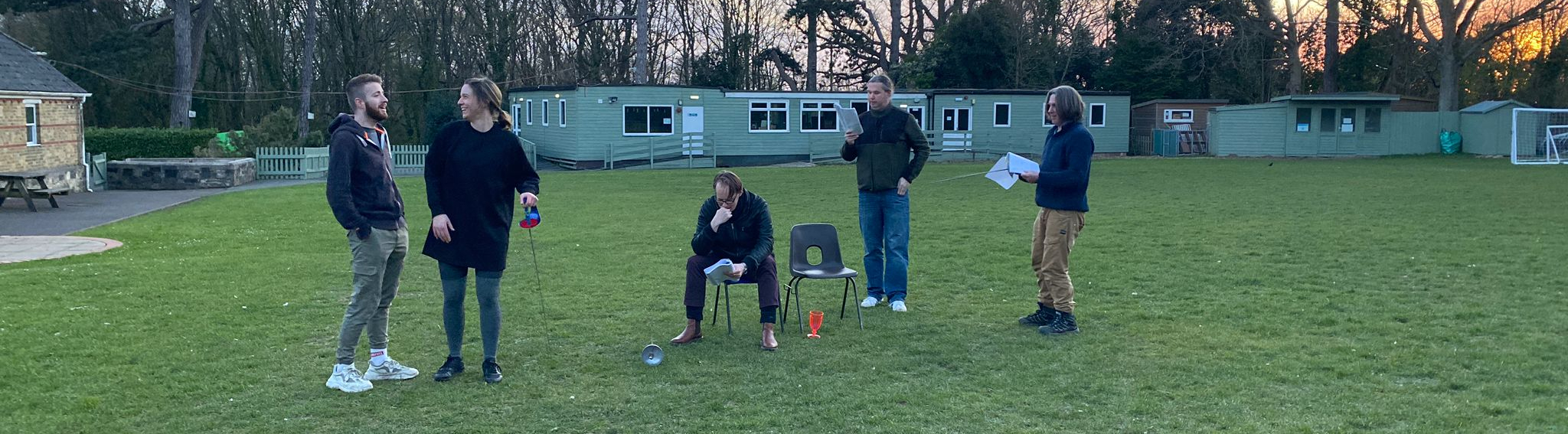
Using Hamlet and Laertes – specifically our Hamlet and Laertes – as an example, the story of the moves is equally as important as the moves themselves, if not more important.

At the start of our first bout, Laertes performs an elaborate, skilled fencing salute and falls into an en-guarde position. Hamlet follows suit, but his salute is laced with cockiness, and he turns to Horatio as if to say ‘can you believe this guy?’ as the bout begins. That’s nut-shelling it in a big way, but in the space of four to five moves you know exactly how both characters are approaching the fight.

Fast forward to a favourite move of mine in the third bout, when Hamlet and Laertes are in a bind (when the foils are locked together and neither can move without giving the other combatant the advantage), and we’ve added a line, three simple words: “Come on, Laertes.”

It’s Hamlet taunting Laertes, mocking him for the fact that he is supposed to be a master swordsman, and here’s Hamlet holding his own against him in a duel that, at least as far as Hamlet knows, has higher emotional stakes for Laerties than it does to Hamlet. To Hamlet, up until this moment, it has been a game. He doesn’t know that Laertes has a sharp and poisoned blade, and so far Laertes has been warring with himself over whether or not to try to strike the fatal blow so he has been holding back some of his speed and strength. This moment, in bout three, is when that changes.

In our fight, this is the moment Laertes makes his decision: he pushes against Hamlet’s blade, pommel to pommel, with such force that Hamlet is sent stumbling, and when he rises he finds Laertes’ blade pointed at his throat.

The balance of the fight has shifted, in one simple move.

It’s clear in the faces of Hamlet and Laertes, in their stances, in the utter silence that follows the move itself, and it’s thrilling for the fighters, the onlookers and the audience alike.

From that moment on, chaos reigns, and the characters are careening towards the end of the play at such a speed that the audience can’t

There are several ‘set pieces’ in this particular play, scenes and moments everyone knows and is waiting for, and the fight is undoubtedly one of them.

For us, putting it together has been a joy, and we can’t wait to see and hear the reaction of the audiences. We really, truly hope it excites them as much as it has excited us…
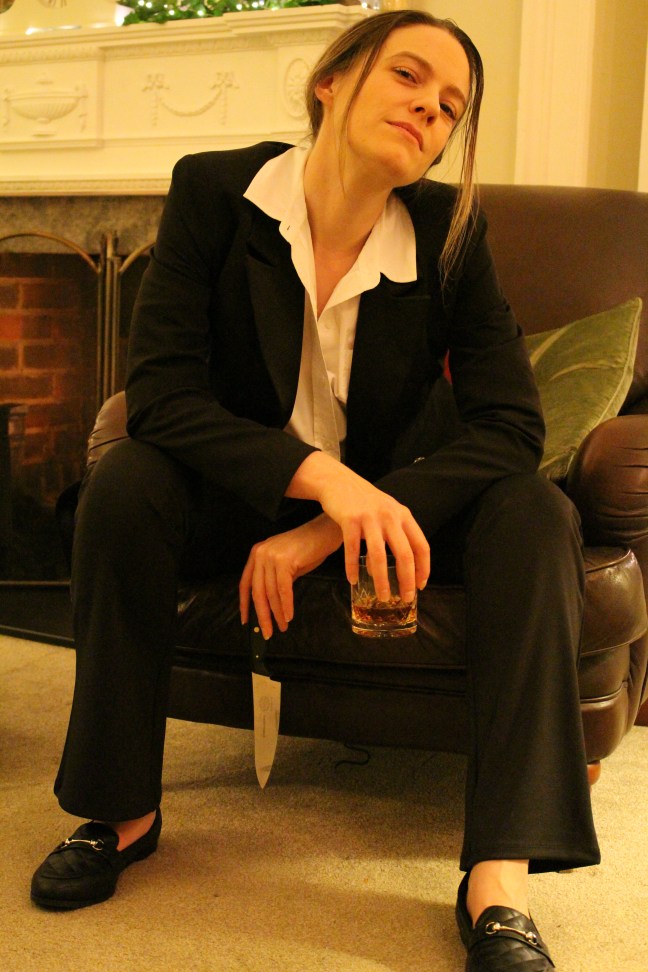

Finding Hamlet

Hamlet is one of those characters about whom everyone who is familiar with the play will hold an opinion. For centuries now, the Prince of Denmark’s dialogue and actions, and his supposed thought process (although, granted, not a lot is left to be supposed once he’s hit his fifth soliloquy and still hasn’t run out of things to say!), have been analysed time and again by actors, directors, scholars, audiences, students and no doubt many others.

Personally, when I first read Hamlet as a teenager, I couldn’t summon an ounce of care for Hamlet himself. I thought he was moody, dramatic, indecisive, over-talkative and frankly a bit of a know-it-all!

My attention fell on Laertes, a character I later had the fortune to play with Origins Theatre. At that time, and for many years, there was no other character in the play I would have considered playing, not even the ‘main man’ himself.

In part, because I always had a thing about flawed hero types, and Hamlet – whilst flawed – was certainly not a hero!

But also perhaps it is partly because I never expected to be given the opportunity. The production I have been cast in was actually planned for 2020, and I was not Hamlet. In fact, I’m pretty sure I was not first in line as Hamlet when the production was first restarted with June 2022 in mind either, so it is safe to say this isn’t a character I ever thought would come my way, and generally when I read plays I tend to hone in on the characters I would like to, or could, play…so, again, Hamlet never really caught my attention!

And, without question, it is also partly because for all the times I had previously encountered the play, I had (to my shame) treated Hamlet himself like ‘white noise’. I had skimmed over his many, many, many soliloquies in favour of reading, listening to and watching those around him, in favour of focusing on the fighting, on the costumes and staging, on the ‘famous bits’.

“To be or not to be: that is the question.”

“There are more things in Heaven and Earth, Horatio, than are dreamt of in your philosophy.”

“Alas, poor Yorick! I knew him, Horatio…”

We all know those lines, but how many people can honestly recall in any detail the words that follow?

When I was offered the part – after a few moments wondering a) if I’d misread the message and then b) if it had been sent to the right person – I accepted with a genuine mix of emotions. Elation at the opportunity, nerves at the scale of it, and a verging-on-unhealthy panic that I would somehow mess it up.

I met with the director, we chatted through his over-arching vision for the play (which is, quite frankly, fabulous!) and its characters, and he placed in me a level of trust that was both exciting and terrifying. And so, I set about finding ‘my’ Hamlet…

Except I didn’t.

The read-throughs went well, very well, but Hamlet and I were merely rubbing along – we weren’t connected. Looking back, I was trying too hard to be the Hamlet I thought everyone wanted to see; I was so focused on not letting anyone down that I was seeing Hamlet’s words on the page, hearing them come out of my mouth, but that’s all they were: ‘words, words, words…’

Our first full rehearsal came, and something clicked – almost. Surrounded by the other cast members, on our feet, moving the play and finding the chemistry between the characters, Hamlet and I fell into step. I even found myself defending some (not all, I hasten to add!) of his actions because I could ‘see where he was coming from’…but there was still a disconnect, not between him and me necessarily but between the way in which I was connecting internally to Hamlet and the way I was actually playing him. It was as though I was filtering something out between my mind and my mouth.

Fast forward to our second rehearsal, Act III, Scene I.

“Are we doing this scene?” I asked. “We haven’t got Ophelia tonight…”

“We’ll do the beginning bit. I want to hear you do ‘To be or not to be,’” replied the director.

In a panic, my instinctive reply was: “But I haven’t decided how to do it yet!”

“What’re you torn between?” He asked.

I hesitated.

Because the honest answer was that I wasn’t torn at all. I hadn’t decided how to deliver it simply because I didn’t want to actively decide how to deliver it. I knew that, in my head, I had locked into Hamlet’s mind-set, or where I felt it was in any case, and had found where he and I were the same, found the moments in which I understood him rather than wanted to slap him, and I wanted this speech to come from there. I wanted all his speeches to come from there.

I just wasn’t sure if that was the ‘right answer’ or not.

So I rambled for a bit at the director, assistant director and at my fellow cast-mates, buying time by asking questions about the staging, talking about the scene that would follow, cracking a couple of jokes, and basically just delaying the inevitable moment when I would have to actually do something important and risk failing miserably.

The irony of that was not lost on me!

I can’t remember how I delivered the speech, not a bit of it, but I do remember – vividly – the moment after, when in a room of people who really do know their Shakespeare, one simply said:

“Emily, that was brilliant.”

And there it was – or rather, there he was.

My Hamlet.

The Mysterious Case of the Abandoned Blog

So far, I believe most of my posts, of which there are not many, have started with an apology.

This one is no different.

Sorry for being such a terrible excuse for a blogger!

The trouble is that every time I put pen to paper – or, more accurately, fingers to keyboard – I find myself worrying: worrying about what to write, worrying about whether it will be interesting, worrying what people will think or say, worrying about whether or not people will support it.

It doesn’t matter how inspired I feel in any given moment, and nor does it matter how much I have to say, I cannot shake the anxiety that surrounds blog writing and I inevitably let my blogging slip away and bury my head in the sand again a mere post or two after surfacing.

I’m going to try not to let that happen this time. Really try. Because I adore story-telling, in all its forms.

Lately, too, I’ve been feeling guilt that I’m sure (or at least hope) is entirely imagined, because I worry that a small number of people in my life will either say my time could be better spent elsewhere, or they will assume this means I will have less time to give to them, or they will deliberately dampen my desire to get myself ‘out there’ simply because it is not something they would, could or want to do…or hear about.

“Don’t listen to them!” I hear you cry. “Your friends should know you better than that!”

And they do. I have some wonderful friends and family in my life, who support me with everything I do, and never doubt that I’ll still be there for them, still do everything we do together with as much energy and excitement as always.

But here’s the thing about me: I listen to everyone, even when I shouldn’t. The voices of the people who don’t know me all that well at all get into my head, and they add layer upon layer to my already considerable self-doubt until I rely solely on the validation and approval of others, the positive reinforcement. These days, being met with negativity or passive aggression makes me panic, faster than anything else.

Anyone who truly knows me knows that I throw myself whole-heartedly into everything I do. I give my all, try my best, and try to see the good in people wherever I possibly can. I will give my energy to you in spades, if you want it, and my positive nature, my drive to succeed. I won’t commit to something unless I want to do it, a fact I always thought was fairly well-known. Still sometimes people question, guilt, wear me down, chip away at my self-worth; and I end up leaving my own hopes and dreams abandoned at the sidelines because I’m afraid that if I pursue them I will be doused in negativity from someone, somewhere. Because I figure they must be right and I must be wrong. And finding the strength to withstand that can be so hard.

I have enough time and passion to go around all the people I know and all the things that I do. I know it, as surely as I know my own name. And those who truly know me also know it…and I love them for it.

Throw in the fact that I have no shows to perform in at present – looking at you, Covid-19! – and it really does seem like the perfect time to get started. Again. And hopefully, this time, I won’t end up writing another blog post in two years’ time apologising for my lack of blog posts!

So we’ll see how we go, and then maybe a few of my other goals will follow suit…

I’ve said that before, I know, and I’ve not kept to it – why should this time be any different?

The truth is, I don’t know that it will be…but at least Approach With Caffeine has come back onto my radar, and I’ve taken the first baby step back towards giving it a shot.

Wish me luck!

Perspective: A Donor’s Journey, Part 1

It’s about time, beyond time, that I actually made good on my ‘I’m going to write a blog’ statement. After a few half-hearted attempts at getting into the swing of blogging, I’ve finally been sparked to write about something. 

I’ve never been particularly good at sharing my negative feelings, or so say the twenty-three blog posts sitting in ‘draft’ that will likely never see the light of day, so I wanted to check in at my thus-far-almost-entirely-abandoned blog with something that, ultimately, I hope proves to be uplifting, something that I could use to perhaps prompt others to do what I did and sign up to the DKMS donor register…so here we are, and here I go:

There are moments your perspective shifts.

Let me take you back: there was a little local boy in need of a transplant – bone marrow or stem cells, I can’t recall which – and there was a drive to encourage as many people to register as donors with DKMS as possible. I registered, in the vain hope I would be a match and could help that little boy, give him a second chance; I wasn’t a match, and I couldn’t help.

I stayed on the register but never thought on it again. It’s not something you think of in your everyday life: ‘I wonder if today will be the day I get asked to donate my stem cells?’ is not a question that habitually runs through your mind, or at least it doesn’t through mine. More likely it’s questions like ‘What should I have for dinner?’ or ‘Why won’t this ache/this pain/this bug go away?’ or ‘Do I really have to work today?’ or ‘Why can’t I be slimmer/curvier/less spotty/less anxious/more confident?’ and so on, and so forth.

Normal questions, normal thoughts, normal worries. Nothing to be alarmed about, nothing that causes you to stop and take stock. The everyday worries so easily suck you in, and you find a choice between two meals or two outfits or two books becomes a drama, a huge decision that rocks your day, simply because you feel, for reasons best known to your subconscious, that you should be worrying about something.

Perspective is a funny thing.

As someone who deals on an almost daily basis with pain, following a pedestrian versus car run-in 18 months ago, I’ve found my perspective has been warped and shifted more times than I care to count in recent months. Some days, the smallest things will rile me up into a state of near-hysteria; other days, I’ll take a more nonchalant approach, with a ‘whatever happens, happens’ type mantra. There’s been no equilibrium for a while, and I’ve spent many a sleepless night fretting over things that, frankly, should not be taking up as much headspace as I’m affording them, allowing worries of all shapes and sizes to drag me down simply because it was easier than fighting back.

Now, I find myself reconsidering my outlook.

A few weeks back, I took a phone call from DKMS telling me that I was a possible match for someone in need of a stem cell transplant in order to survive.

This isn’t a ‘please, I need a break, or else my hip is going to hurt all day’ scenario; this is a ‘please, I need a stem cell transplant, or else I’m probably going to die’ scenario, and that is a very different beast.

So I went  – who wouldn’t? – to the confirmatory blood test and I filled out a fairly lengthy questionnaire and I didn’t hear anything else at first. My donor journey was over, I thought –  there had been several possible matches lined up so I hoped and prayed that one of them had been deemed suitable where I clearly wasn’t. As it turns out, that ‘one of them’ was me.

The phone call I received on Monday 24th April 2018 isn’t one I will forget in a hurry, possibly ever.

Call me dramatic, but it had a profound effect on me, hearing the words ‘You are a match and we want to proceed with you as the donor.’

Honestly, once I’d asked my questions and we’d set the various dates required for the process to take place, I felt really rather emotional…not through any sense of righteous heroism – after all, who in their right mind would register and then refuse to donate without a bloody good medical reason? ‘Being nervous’ doesn’t cut the mustard for me as an excuse when someone’s life may hang in the balance.

No, what got me emotional was how selfish I suddenly felt. Whilst I’d been sat on my phone complaining to my friends about rib pain or a cough or the traffic or someone rubbing me up the wrong way, someone, somewhere, was sat simultaneously wondering if they’ll see another Christmas, perhaps wondering whether they’d see their child’s first birthday or make it to their own wedding day, perhaps wondering if they’d ever be able to return to work, but almost certainly wondering how long they have left, wondering if their ‘match’ was out there, if they’d be found…

Doesn’t that just put the everyday things in perspective?

This week’s medical assessment had a similar effect. A trip to London for more blood tests, another questionnaire, a chat with a doctor and a nurse, a urine sample, an ECG, a chest x-ray, a blood pressure test, a height and weight measurement and a walk-through of what happens next…

Whilst I will be having four days of injections of a substance called G-CSF, which will encourage the growth of white blood cells in my bloodstream, in the run-up to the donation, the patient on the other side of the coin will be undergoing a high-intensity course of chemotherapy to strip away their immune system, leaving them ready to receive my healthy cells but also leaving them entirely vulnerable. If I was to pull out, in those final days, the odds are high that they would die. That, obviously, is not an option featuring anywhere on my radar.

Every time I read the letter, see the dates, I wonder when the patient themselves will be told there’s a match. After my medical assessment has hopefully confirmed I’m fully suitable as a donor, I suppose, to avoid getting their hopes up only to dash them if something crops up that renders me unsuitable.

Providing there are no problems – I have one more test to clear – then the donation will happen in just under two weeks. It will take four to six hours on day one, with a possible further few hours on day two if they can’t harvest enough cells in the first session. The blood will be taken out of one arm, the necessary cells will be harvested and then the blood will be returned through my other arm and I’ll be in and out just like that; if the veins in my arms are unsuitable on the day, they’ll go through a vein in my neck, which then requires an overnight stay in hospital. One night. Who knows how many nights the recipient has spent in hospital over the last weeks, or months, or years?

Perspective.

“You can bring your iPad or something, on the day of the donation” they said to me. “Or you can bring someone with you, if you’d like.”

No…

I think I’ll just sit, and count my lucky stars that I’m on the donor’s side of the register, with my fingers and toes crossed that maybe, just maybe, something as simple as my peripheral blood stem cell  donation (try saying that quickly!) could save someone’s life.

To find out more about DKMS and stem cell/bone marrow donation, visit their website and take a look around. And if you aren’t eligible to register to donate yourself, there are plenty of other ways you can help!

Car Trouble…

I’ve never been one to argue the toss on the matter of speed, on what classes as ‘too fast’ or ‘too slow’ in a residential area.

Recently, on the Isle of Wight, there have been proposals put forward and discussions had around reducing the speed limit in towns and villages to 20mph. When I first saw this, I joined the frustrated mutterings of the masses:

“That’s a snail’s pace, how ridiculous.”

“30mph is slow enough, surely!”

“Hardly anyone even lives there, why do we need to drive that slowly?”

And then I got hit by a car.

One month ago today, I was happily making my way home, ambling through the lanes of my village with the dog. As dogs are wont to do, he insisted on sniffing everything, and on relieving himself on most of the things he sniffed. We’d been out for over an hour, enjoying the sunshine and fresh air, and were just two minutes from home when Oscar paused to make the air smell distinctly less fresh!

I consider myself to be a responsible dog owner, so, naturally, I removed his leavings from the verge. I was tying the doggy bag when there was the most godawful bang. I opened my eyes to find myself staring at the verge on the opposite side of the road; I could hear screaming (embarrassingly, it later transpired that this was coming from me, although I’m sure that can be forgiven!) and a few seconds later I heard my dog barking as people left their houses to see what on earth had happened in our normally sleepy village.

Mercifully, following a six-hour visit to hospital – and here I would like to praise the NHS, for which I have a renewed appreciation – it turned out that nothing had been broken, thanks to my being totally unaware of what was about to happen and simply ‘rag dolling’, rather like a drunk falling down the stairs. The lack of broken bones was welcome news, but also a revelation that surprised the doctors, me and everyone I’ve spoken to since, many of whom have decided that I must possess an Adamantium skeleton! The damage, therefore, was largely in the form of deep bruising and soft tissue injuries.

And shock.

Shock was not something I expected to affect me so deeply, but even now, almost a month on, I find myself spacing out or bursting into tears at random, seemingly for no reason whatsoever. Emotions are heightened and filters damaged, and my patience is worn thin far quicker than before.

By nature, I’m not a nervous person, nor am I an angry one. But I have become both over the last few weeks. Sleepless nights, random tears, constant muscle cramps and a leg that seems intent on buckling at the most inconvenient moments, among other things.

But I’ve also become a better driver, a more patient driver, and – although I am still unable to drive long distances – when I drive now, it’s with more patience and a keener attention to reading the road than ever before.

I have stopped my mutterings about reducing the speed limit. In fact, I’m all for it; not because of what happened to me, but because of what could have happened, if what happened to me had – moment for moment – happened to someone else…

As I said to my mother: “Of all the villagers who walk their dogs along that road, I’m glad the car hit me.”

I’d rather it hadn’t happened to anyone, of course, but that is neither here nor there.

Imagine, for a moment, that it had been one of the village’s many children, proudly adhering to their newly-learned Highway Code, trotting along the road with a parent or a pup or both. That car’s wing mirror, which was ripped off by my hip, could have been at head height. Game over.

Or picture this: an elderly resident with their equally frail dog, shuffling home, limbs aching and ready for a cup of tea. A shattered hip? A broken leg? An extended hospital stay either way, no doubt, and a much longer road to recovery.

Or perhaps it could simply have been someone a few inches shorter, whose ribs would have taken the brunt of the impact; or someone taller, whose knees would have been on the receiving end of the force.

So I stand by what I said – if a car had to hit anyone, I’d rather it as a fit and healthy 26-year-old with a sunny disposition. Yes, it’s hindered my change of jobs and made the process exceptionally stressful; yes, I’m angry to be facing physiotherapy, taking four different types of painkillers a day, three times a day; yes, I’m tired from sleepless nights and fed-up of not being able to drive great distances, sick of not being able to rehearse and perform at full capacity – but, with any luck, it’s only temporary.

Nothing’s broken, nobody died, and perhaps some of the people closest to me will think harder now when they set out in their car, about their driving habits, from concentration to speed.

20mph may seem slow – it did to me, too – but perhaps at 20mph, that driver would have seen me. Perhaps they would have braked. Perhaps they would have noticed, with that extra second, the pedestrian walking their dog and taken evasive action.

It might be that the speed limit does not need to be reduced in towns and villages, if drivers are willing to perk up and pay attention, and slow down of their own volition. But so often I see people speed through my village at 30mph, not a fraction less, and where before I would simply grumble ‘too fast’, now it makes me shiver.

The speed limit, as most drivers do understand, is not the speed at which a person must drive through the area, but instead the upper limit; if more people drove flexibly, adjusting their speed according to the time of day, state of the road, weather, knowledge of the area and even how they themselves are feeling, then maybe accidents like mine – and worse – could be prevented.

Something to think about…

The light is dimming…and the dream is, too.

What do you do when a dream comes true?

Celebrate, of course, and thank your lucky stars that you were fortunate enough to accomplish something you wanted so badly.

But what comes next?

OvertureI’m facing this question at the moment and, rather poetically, it’s all because of a musical about dreams…

After every show, I write a Facebook status, proclaiming how thankful I was to have
been a part of it and what it meant to me, often throwing in a few anecdotes and a photo or five to illustrate the point.

Jacob and SonsThis time, I wrote just one line: ‘May I return to the beginning…’

Every show is special, but sometimes you happen upon a production with an extra something. You can’t name it, but you know it’s there.

Joseph and the Amazing Technicolor Dreamcoat was one such show. Except it wasn’t. When the curtain fell on the final performance, I fell to pieces and it was up to the unfortunate Pharaoh (sorry, Brad!) to pick up those pieces, while the Choir, Chorus, Brothers and Joseph looked helplessly on, some certain they were just witnessing another attack of the normal post-show blues, others – rightly – not so sure.

Joseph's DreamsJoseph went above and beyond everything I had ever imagined, and I couldn’t put my finger on what it was that made it that way, because every time I thought about it, I’d find a way to convince myself the dream hadn’t ended: there was the after show party, the reviews, the feedback on social media, the DVD, the photographs…
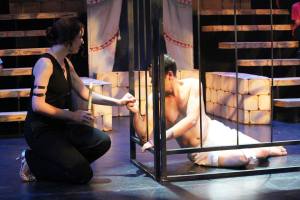
It ended a couple of weeks ago, though, with the presentation of £6,275 to three charities. It was the last meeting of ‘Team Joseph’. And as I drove away from the presentation, towards a rehearsal for another show, I cried.

Because Joseph was not ‘just another show’.

Go Go Go JosephFor the eight-year-old, who performed in Joseph at primary school and gazed up at the Narrator, wishing to be them and willing herself to be worth that role, it meant a childhood dream come true.
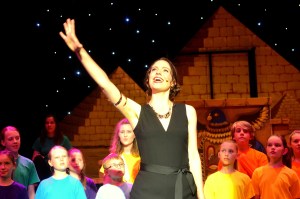
For the eleven-year-old, who mimed the hymns in school assemblies because the other girls sniggered at her because singing in assembly wasn’t ‘cool’, it meant beating the bullies who stole her voice.

For the sixteen-year-old, who hated the way she looked, with her spots and her braces and her puppy fat and her frizzy hair, it was a boost in self-esteem that no money could ever have bought.

DSC_0720For the twenty-three-year-old, who auditioned time and again for musicals, who gave her all and was still overlooked every single time, who was left wondering if maybe she just wasn’t good enough, it was proof that she had the talent to hold a leading role…and the reviews proved she could nail it.
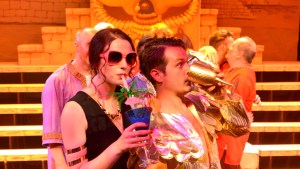
For the twenty-six-year-old, the jaded twenty-six-year-old, who was buckling under the pressure of other people’s problems without a word, it was a place to be happy.

DSC_0526I said to myself, several times during the rehearsal process, that I didn’t know what I’d do when Joseph ended, because I was pretty sure it was the only thing holding me together. And those I told laughed it off, or dismissed it as typical thespian drama, or just glossed over it with a worry of their own.
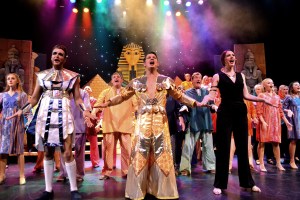
The problem is, I wasn’t joking.

I’m struggling now, and scared to say as much for fear of the reprimands I will face from people who perceive it to be ridiculous that something so commonplace as a musical could hold someone together.

Some people perform for a living, and some live to perform. I fall into the latter category, and there are always post-show tears and post-show blues, but this time it was – it is – different. So much of my heart and soul went into Joseph that, some days, I don’t think I even came out of character. It consumed my every spare moment, and some moments that were not so spare; I’ll confess that more than once I doodled the names of the colours and characters on notes taken during a conference call.

Joseph will have a place in my heart for as long as I live, and I’m not sure anything will ever match the whirlwind of emotions that I felt at every rehearsal, every performance. Frankly, the number of times I got home from a rehearsal and cried with happiness is just embarrassing.

DSC_0470 (1)And when the curtain went up on opening night, and Joseph – played, incidentally, by one of my dearest friends – came over to me during his first rendition of ‘Any Dream Will Do’, we grasped each other’s arms for a few bars longer than directed, willing each other not to cry because we’d done it. It was really happening, and neither of us could quite believe it.
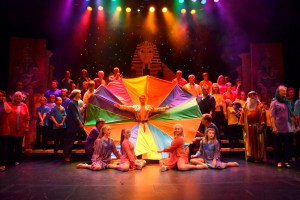
Moments like that are ones that, if I call them to mind, make me feel like I’m there again. They’re moments I will never forget.

In January 2015, when I suggested to the committee that we tackle a musical, and I had to pitch for forty-five minutes to convince them we could do it, I never dreamed that I would wind up playing the Narrator, part of a cast and crew in excess of eighty impossibly talented people.

And now it’s over, I feel a sense of loss that I can’t quite place, and all the things that were so easy to deal with before are suddenly so much harder to handle.

DSC_0498I need to find a new dream, I suppose…but no matter how I try to fix on something I want as much as I wanted that, I come up blank. What comes next, I don’t know. Perhaps it will hit me one day, with as much force as this one did, but – at this moment – I am very much of the opinion that, truly, any dream will do…

Fighting Fit?

I’m not unfit: I can dance round a carnival route for two hours and still have energy left, perform a four-minute song-and-dance routine without breaking a sweat, I can engage in an intense sword-fight whilst delivering a heroic monologue without pause, and I can (usually!) partake in a one-hour Zumba class without getting too out of breath.

Why, then, when challenged with a 10-minute ‘fat-busting solution’ DVD, do I find myself gasping for air well before the ten minutes is up?

Fitness DVDs, I’ve decided, are not designed to make you feel fitter. In fact, I think their aim is to make you feel as unfit as possible, so that you go out and buy more fitness DVDs!

Woman doing sit upsTwo minutes in, I’m planking, I’m hurting, I want to lie down.

Three minutes, I’m doing a strange, twisted version of ‘put your hands in the air like you just don’t care!’

Seven minutes, I lose the will to continue and decide that the floor is the best place for me.

Ten minutes: “Good job!”

I look up from my face-down sprawl to see a cheery American giving me a thumbs up. She doesn’t look tired. Either she’s had a coffee-and-cake break between each segment or else I’m just bitter at discovering I’m not quite as fit as I thought…I suspect it is the latter.

For beginners, she said; I dread to think what she puts her advanced consumers through.

A few hours later, I was working my proverbial socks off in a three-hour rehearsal: singing, dancing, acting and barely stopping for so much as a swig of water.

It repaired a lot of the damage done by the day’s earlier fitness failings and it got me thinking. Fitness DVDs, I decided, are like clothes – it’s all about finding the right style for you, and not taking it to heart if what you’ve bought doesn’t quite fit. Unfortunately, unlike clothes, you can’t return them after you’ve tried them!

So, the next day, the fitness DVD went into a drawer to join its many predecessors.

I don’t intend to take it out again.

‘Tis the Season to Drink Coffee

Friday morning, eight am. First in line, as I am every year, to receive a Starbucks eggnog latte and go skipping off into the day ahead, hyped up on caffeine, sugar and festive cheer.

I’m not sure when eggnog lattes became such a staple of my diet, but what I do know is my bank account suffers each year between November and the new year and the primary culprit is Starbucks. Not Christmas shopping, not even my fabled Christmas sandwich tours; no, it’s Starbucks.

I live in a rural area and I’m a big supporter of local, independent coffee shops; for ten months of each year, I simply don’t touch the coffee chains except in times of necessity. Seven o’clock in the morning at London Waterloo, for example.

But when November strikes, my allegiance shifts. Whether or not they dodged their taxes, that’s not the coffee’s fault, nor the fault of the unfortunate barista who witnessed me crying when he handed me my first eggnog latte of the season.

“I do this every year,” I sniffled, ripping a napkin from the holder to dab at my fast-running mascara.

He fixed me with a look that was somewhere between amusement and wanting to call security: “I’m not sure if that makes you more or less weird.”

I think I have a problem.

Day one and I’m already £12 lighter. It’s going to be a long two months.

A Scorching Sequel

I’ll admit, I published these a little out of order, but I was so excited by the hints at the third film that I figured the review of the second could wait a little longer! But, without further ado, here it is…

Trilogies.

It is a truth universally acknowledged that the middle film in a trilogy is often considered to be the weakest. A filler between the introductory first film and the climax of the third.

Maze Runner: The Scorch Trials, I applaud you. You have broken away from ‘middle film syndrome’ to become one of the hottest films of 2015.

Following the events of The Maze Runner, Thomas (Dylan O’Brien) and his friends from the Glade are thrust once more into danger by the organisation known as WCKD, all in the name of a cure for the brain-rotting virus, The Flare, which is eating away at people’s humanity and turning them into little more than living corpses. Scary ones.

But WCKD’s methods are somewhat controversial. They insist that the key to a cure is an enzyme found in the brains of the young – the Immune – and are set on harvesting it to further experiment. Naturally, Thomas and co. won’t stand for this, and they escape into what’s left of the world outside WCKD’s compounds: the Scorch.

For fans of the books, of which I am one, a lot of changes to the story have been made. Some plot points are missing, some have been added and others have been twisted almost beyond recognition; but each change that has been made is set to marry up with the events of the third book so beautifully that it’s hard to disagree with the reasoning.

The film is high on action and low on dialogue. This could have proved detrimental to character development, and with a lesser cast it might have done, but instead it gave the actors a chance to fine-tune their characters through their actions, which spoke far louder than their words.

O’Brien as Thomas is every inch the action hero. He’s lost the innocence he had in the first film, as Thomas battles his way across the Scorch. Ki-Hong Lee as the sassy Minho also deserves a mention, stealing more than one scene with his witty interludes.

The stand-out performance, though, comes from Thomas Brodie-Sangster as Newt. A master of subtlety, Brodie-Sangster can say more with one look than many actors can in an entire film.

It is when O’Brien, Lee and Brodie-Sangster are together, though, that the film is at its strongest. A trio of formidable young actors with a strong off-screen friendship that translates beautifully to their characters, it is almost impossible to take your eyes off them whenever they appear together on-screen.

That’s not to say the rest of the cast isn’t strong; it is. There are some sterling turns, particularly from Giancarlo Esposito as Jorge and Rosa Salazar as Brenda, not forgetting the suitably sleazy Aiden Gillen as Janson.

As a stand-alone film, this is a league above the second installments of The Hunger Games and Divergent. But the real telling point will be the third and final film – The Death Cure, set for release in February 2017 – when we see how Wes Ball has finished adapting the trilogy for the big screen.

Will the changes he made in The Scorch Trials’ transition from page to screen be resolved and justified in The Death Cure? Or will they lead to bigger, bolder changes with which even the most die-hard film fans will struggle to get on board?

It could go either way…

So you want to date a Busy Person….

As you’ll remember from my ‘Nervy Girl’s Guide to Online Dating’, a few months ago, my mother convinced me to sign up with an online dating website. Apparently, I had been single for too long and it was time to get back on the dating scene and she simply wouldn’t drop the matter, so I reluctantly agreed to create a profile.

I added the obligatory photographs of me a) on a snowy mountain to show off my adventurous streak, b) in fancy dress to show my silly side and c) looking elegant and refined to show that I’m a classy girl. I penned some slightly awkward waffle about myself, filled in my personal details and hit ‘submit’.

Eighty likes in one hour.

Well, that would be enough to boost anyone’s confidence, and I started to feel quite positive; of that eighty, however, only two made it to a first date. Call me picky, but giving up what little free time I have in my diary is a big deal for me and I wasn’t about to waste my time giving it up for people I knew already wouldn’t make it past the first coffee.

But these two seemed promising: one was a teacher and the other worked in the media. Both sturdy jobs with good prospects, both with a good grasp of grammar (trust me, it’s important) and both seemingly charming…at least on paper. So I agreed to meet with each of them for coffee and see how it went.

Prospective Boyfriend No. 1 had hairy ears, but that wasn’t a deal-breaker. He was also fairly serious, but I put that down to nerves. Prospective Boyfriend No. 2 was a bit over-eager, and spent a little too much time talking about semi-naked women in cabaret bars, but that was forgivable – he was the one that made me laugh, after all, we all have our vices!

Never judge a man by a first date, that’s what I’ve learned.

After a few hours spent with each, I fully intended to give them both a second date, but when they both got in touch this week to try to fix something up, my diary simply didn’t have the room to accommodate them. And the news did not go down well.

A curt text from PB1 accusing me of silent treatment when less than 24 hours had passed since the last message when I had, in fact, not actually had access to my phone. Then arrived a series of similarly short messages from PB2 insisting I must have a spare ‘appointment’ somewhere in my diary to fit him in. How strange. Where was the casual ‘stay in touch and let’s see where it goes’ approach? The charming text messages and e-mails? The carefree attitude that came across when we sat chatting over coffee…

That’s the problem with a first date. You meet the dating profile rather than the person: they’re out to impress and so are you. I’m a guilty party, too. To an outsider, my life sounds exciting and I’m happy to make it sound that way: film set anecdotes, silly stories from trips abroad or publicity stunts, a colourful employment history filled with everything from being a party clown to a charity fundraiser.

Having all these stories and experiences in my arsenal makes for a great first date, but the Prospective Boyfriends only heard the ‘Director’s Cut’ of these tales. Left behind on the cutting room floor were the seventeen-hour days filming in the rain, the hours spent driving up and down motorways with a precariously balanced birthday cake on the back seat, and the mountain of administration that accompanies a fundraising event.

Don’t get me wrong, a busy person comes with a lot of great qualities: we’re reliable, we’re punctual, we’re dedicated, we’re passionate and, although it might not be as frequently as you’d like, we’ll give you one hundred percent of ourselves when we do see you.

The downsides?

Dates have to be planned like meetings, well in advance. To get a coffee date, you need to give us two weeks’ notice. If you want to catch us for dinner, we need to know three weeks in advance. A day trip? Give us a month. A weekend away?

…Good luck.

We’re not hopeless causes. Some friends of mine are like ships that pass in the night and they’ve been happily married for two years now – they never run out of things to talk about and they value their time together as so precious that every moment they can grab is filled with love, laughter and passion.

I suppose what I’m trying to say is that just because we’re out there, living life to the full, it doesn’t mean we don’t want a relationship. But it does mean that our free time is precious and, unfortunately for any prospective significant others, there aren’t many spare moments to be had. You may find yourself being dragged to rehearsals, press-ganged into volunteering at events or hiking up a mountain, or having to fit an entire week’s worth of catching up into a one-hour lunch break.

But I promise you, we’re worth the patience it takes to be with us. For every ounce of frustration, there’s a laugh to be had later; for every day you can’t see us, a new adventure will be waiting around the next corner for when you do; for every low, there will be a thrilling high.

After all, you don’t board a rollercoaster expecting it to be an easy ride.